Monday, October 13, 2014

0070 迎


This character means ‘to meet, receive, greet.’ In Japanese it’s pronounced GEI or mukaeru, and in Chinese it’s yíng.

The element that wraps around the left and lower sides


means ‘walk, walking.’ The rest of the character,

,

is there to give a sound clue. As usual in these cases, it’s up to the learner to figure out some way to make the character memorable. To me, 卬 looks like a pair of swinging doors in an old Western saloon. I can imagine a meet-and-greet taking place right near those doors after a walk up the dusty street.

0069 崩


This character means ‘to crumble, fall to pieces, collapse.’ It’s pronounced and kuzusu in Japanese, and in Chinese it’s bēng.

The upper figure


means ‘mountain,’ and the representation is pretty transparent. Three peaks. The lower part of the character consists of two of these:

.

And each of them means ‘moon, month.’ They are just there as phonetic clues to the pronunciation of the word.

The archaic forms


suggest a way of remembering the character’s meaning. Can you see the moon characters as a representation of an avalanche down the slopes of the mountain?

Saturday, October 11, 2014

0068 頭


This character means ‘head’ (the one on your shoulders) as well as ‘head (of an organization), leader, top.’ In Japanese it’s pronounced many ways, including , atama, kōbe, and kashira, and in Chinese it’s toú.

The right-hand figure


once represented a man: a head upon a body. The two little bits on the bottom are the body; the majority of the figure above that is the head. (Currently in Japanese and Chinese, though, this character means ‘page, sheet.’)

The left-hand figure


means ‘beans, peas,’ and is there to supply a sound hint for the character. Most of the sound-hint figures we’ve seen so far have been on the right side of the character, but here’s one on the left.

Thursday, October 9, 2014

0067 弱


This character means ‘weak.’ In Japanese it’s pronounced JAKU or yowai, and in Chinese it’s ruò.

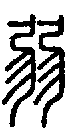
The archaic character below looks almost exactly like today’s version:

.

Sears gives a wonderful and very easy-to-see explanation: it’s a picture of two wings of  a baby bird. And what could be weaker than that?

Tuesday, October 7, 2014

0066 店


This character means ‘shop, store,’ and is pronounced TEN or mise in Japanese and dìan in Chinese.

The outer figure

广

represents a hut, shed, or shop, according to Wieger. The inner figure


is only there to provide a phonetic hint. It means ‘to hold, occupy’ in Japanese, but in Chinese (and Japanese, too) it means ‘to tell fortunes.’ I'm guessing that the upper two perpendicular lines represent the crack that appear when tortoise shells are roasted for divination, as we learned in an earlier post. The mouth below is probably uttering the prophesy.

For learning today’s character, perhaps it would help to remember the phrase ‘hold down the shop’ in order to learn two characters at the same time. Alternatively, this might be a fortune-teller’s shop.

Sunday, October 5, 2014

0065 考


This character means ‘think, consider,’ and is pronounced kangaeru in Japanese. In Chinese it’s pronounced  kǎo and means ‘to examine, test.’

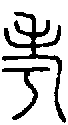
Sears says that it’s a picture of an old man leaning on a cane, and that the Chinese meaning went from ‘depend on (the cane)’ to ‘test, examine.’ Wieger thinks that the ‘examining’ developed because it was up to the elders to examine pupils and candidates. He also thinks that the supposed cane in the character is really an abstract portrayal of ‘difficulty in breathing.’ “The line bent up represents the breath that tries to go out, but is checked by the transversal barrier.” And in this character, he says that it represents the asthma of old men. (See 'Useful Information' for information about Sears and Wieger.)

It’s hard to see what all of the appendages represent for the old man. Legs, arms, and a hat?

Here are some of the charming archaic forms:


Wednesday, October 1, 2014

0063 町


This character is pronounced CHŌ or machi in Japanese, meaning ‘street, town, quarter’ and dīng in Chinese, meaning ‘a raised path between fields.’ The right-hand element


means ‘a field, a (rice) paddy,’ and the right-hand element


means ‘a city block-size area,’ and is also used as a counter for dishes of food, blocks of tofu, and guns (!) in Japanese, but in Chinese it means ‘a male adult; robust, vigorous.’ Wieger says it originally pictured a nail, with the head and the shank apparent.

It’s easy enough to remember ‘field,’ based on the left-hand element, and the right-hand element could be seen as two streets coming together in a T-junction.