Friday, September 26, 2014

0049 夢


This character means ‘dream.’ It’s pronounced MU or yume in Japanese and mèng in Chinese.

The top line, with two vertical hatches, represents eyebrows, and the horizontal three-part bar below the eyebrows is an eye, which stands in here for a sleeping man. He’s lying on a horizontal bar—a bed—and below that is a crescent moon. The meaning is ‘dream.’
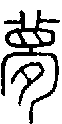
The eyebrows are clearer in the archaic character above, where they are perched over a single eye.

You see above the ‘grass radical.’ It seems not to be used as an independent character, but appears in many plant-related characters. However, the same symbol can have other meanings and other derivations, as in today’s kanji, where it originally showed a pair of eyebrows.

This character has a special characteristic that makes it easier to remember: it’s totally off-balance. Most characters are firmly grounded and balanced, whether on feet, on a box, a line, or one or more supports, whether symmetric or not. Firmly grounded characters would not fall over to one side. Today’s character, however, rests on one tiny point far to one side of the character’s center of mass, and it looks very unstable.

0048 呼


This character means ‘to call,’ and is pronounced KO or yobu in Japanese and in Chinese.

A mouth for calling out is on the left and the character on the right


provides the sound clue. It serves as a question mark when written on its own, but no one has a good explanation for the symbolism when used in 呼. Many kanji are like this, essentially arbitrary symbols. In this case, I see a person wearing a broad hat calling out with arms raised.

0047 過


This character means ‘to pass, go past, exceed’ and ‘error.’ The pronunciation in Japanese is KA or sugiru and in Chinese it is guò. The figure wrapped around the left and bottom sides


shows a succession of footsteps, thus ‘to pass, go past, exceed.’

The remaining element


is said to be there for phonetic reasons. However, it means ‘crooked mouth, evil, dishonest,’ and maybe that’s how the meaning ‘error’ got attached to 過 .

0046 何 vs 向

The character above means ‘what, which’ and also ‘why’ in Chinese. It’s pronounced KA, nani, nan, izure, or dore in Japanese, in Chinese. I had trouble looking it up and realized I’d confused it with Kanji-of-the-day 0029 向 (the text of which is pasted in below for reference). I thought maybe they were just typographical variants of one another, but, no, they are totally separate.
The left-hand element (almost-but-not-quite-connected to the hook on the right) is the vertically compressed form of ‘man’ . The man has a scythe or hoe (the right-hand element) over his shoulder. How that signifies ‘what, which, etc.,’ no one tells us. Maybe he’s heading out to harvest knowledge from the fields of wisdom (which might be the small square in the middle), asking, ‘What? Which? Why?’ with each swing of his scythe.
__________________________
(reprint for comparison) Kanji-of-the-day 0029 向
This character means ‘face toward, turn toward,’ (mukau/muku), and ‘opposite side,’ (mukō) in Japanese. It’s xiáng in Chinese, meaning ‘toward, direction, trend.’ Some of the ancient versions were pretty close
,
but others were much more intricate
.
The idea is that the square or circle represents a small round ventilation window in the northern wall under the roof. Did people want to face that window? Not clear.
外向

means ‘extroverted, outgoing,’ which is clear from the combination of characters meaning ‘outside’ and ‘face toward.’

0045 首


This character means ‘head, neck,’ and is pronounced SHU or kubi in Japanese and shī in Chinese.

Here’s an ancient form:

.

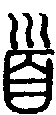
The idea seems to be that this character is just a representation of a head with hair.

Without the hair


we have another character that just means ‘self, oneself.’ It is said to represent the nose, to which Chinese point when they refer to themselves.

0044 師


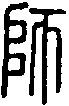
This is SHI in Japanese and shī in Chinese, meaning ‘teacher, master; army.’ There are conflicting stories about this character. Sears says that the left-hand element represents a bow (a compound bow, I assume) and the right-hand character is an inverted foot, here indicating ‘to follow.’Perhaps one follows the leader who has the bow, or follows the arrow shot from the bow of wisdom by the teacher. Here’s the archaic character:

.

0043 事


This character means ‘thing, matter, business, affair,’ and is pronounced JI or koto in Japanese and shì in Chinese.

The image is of a hand (the three lower horizontal lines) writing down (with a brush, the long vertical stroke) what is said by a mouth (the rectangle below the upper horizonal line), ergo ‘business,’ according to Sears. However, Wieger says it’s the hand of a son inviting the (upside-down) soul of his ancestor, hence ‘to serve,’ and providing service is what business matters are all about.

The ancient versions look very much like the current version:

  .

Instead of a mouth, the rectangle is interpreted, according to this theory, as the head of the upside- down humanoid ancestor.